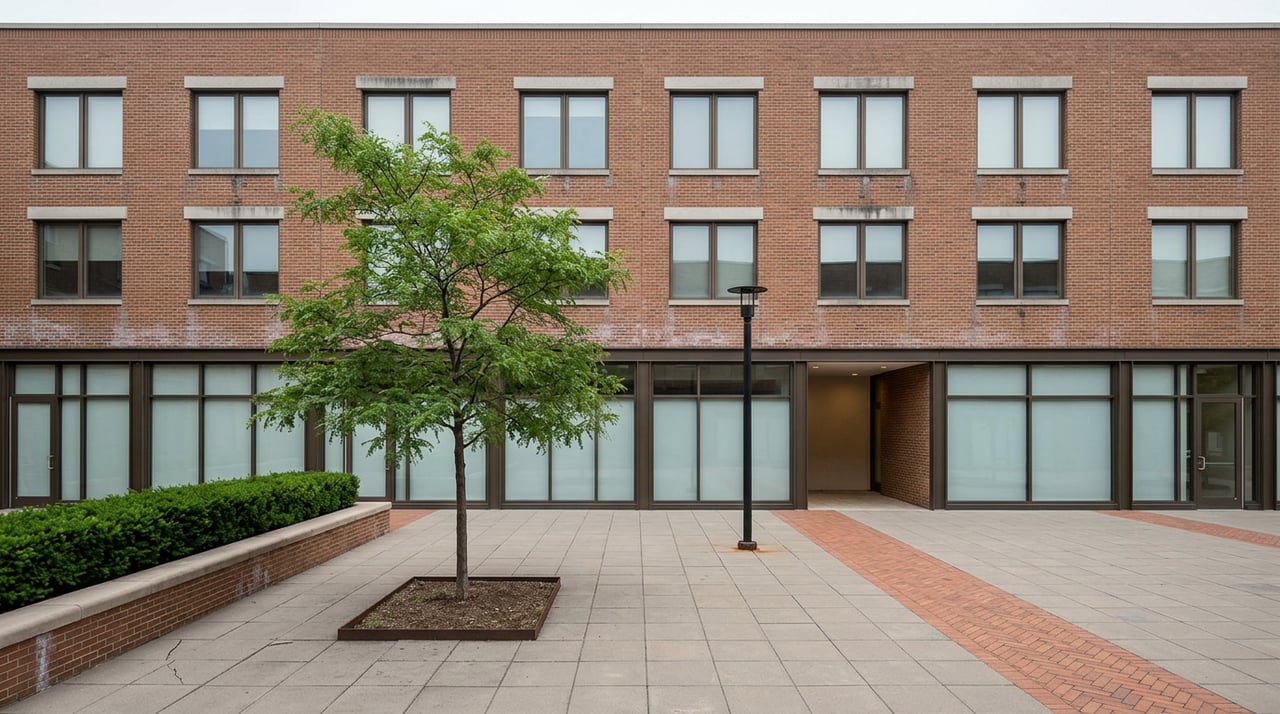
What's New in Logan Square? Plazas, Dining & Change
As Streetsblog Chicago reported, more than a hundred neighbors, dignitaries, and performers stood where cars used to drive on a Monday morning in June. Ballet Folklorico de Chicago danced on a strip of pavement that had carried Milwaukee Avenue traffic and was now a linear plaza cutting through the green space at the Centennial Monument. It was the ribbon cutting for the Milwaukee Avenue Streetscape and Logan Square Redesign Project, and after roughly a decade of planning and two full construction seasons, the road that used to split the square in half was gone.
That is the part worth sitting with. Not that construction ended, every long project ends eventually, but that the thing built in its place changed what the middle of the neighborhood is for. Milwaukee Avenue no longer runs through Logan Square. It runs around it. And every business decision made in the neighborhood since then, from a cafe opening on California Avenue to a Korean street food counter taking over an old bar, is a bet on that new shape.
For as long as most current residents have lived here, Milwaukee Avenue sliced directly through the park surrounding the Centennial Monument, the column locals call the Magic Eagle. Cars ran through what should have been a place to sit. The permanent fix started in March 2025, when the Chicago Department of Transportation closed that short segment of Milwaukee through the park to vehicle traffic for good, rerouting the corridor to the outer lanes around the circle. The full project stretched from Belmont Avenue to Logan Boulevard and carried $21 million in federal funding. At the ribbon cutting, as Streetsblog Chicago reported, U.S. Rep. Delia Ramirez drew applause when she said, "This is how federal funds should be used!"
By the time the main streetscape work wrapped this June, the traffic circle had converted to two-way flow, the square had gained raised sidewalks and curb bump-outs, and the pedestrian core that used to be a through-lane had become, simply, a place to stand still.
The redesign did not just remove a road. It added two new plazas, with a third on the way.
La Placita is the one with the clearest intention behind it. As Streetsblog Chicago reported, Pastor Juan Pablo Herrera spoke at the ribbon cutting about what the design was reaching for:
"Latinx families built this community, bringing traditions, food, music, faith, and dreams."
The project also restored eight historic globe light fixtures around the monument to their original design by architect Henry Bacon, a detail Logan Square Preservation had pushed for. None of this shows up on a map as anything more than "new plaza," but it explains why the space reads as intentional rather than incidental. It was built to be used, not just crossed.
The clearest proof that the new layout changes how the neighborhood functions is what happened to its biggest annual event. The Logan Square Arts Fest, which has pulled in more than 400,000 visitors since it started in 2009, sat out 2025 entirely while construction tore through the plaza it normally occupies. There was no version of the festival that could happen around an active construction site.
It came back June 26 to 28, 2026, and organizers did not just restage the old event in the old footprint. They built it around the new one, doubling the art and vendor space and running two stages instead of one, with Porches, Bad Bad Hats, and Catie Turner topping the bill. The festival's food and drink side has long leaned on neighborhood anchors like Revolution Brewing, The Whistler, Lula Café, Dark Matter Coffee, and Café Con Leche, so the vendors were familiar. What was different was the room they were standing in. A festival that used to compete with car traffic for space now has an actual plaza to fill.
Some of the clearest evidence of the neighborhood repositioning around its new center is happening one block off Milwaukee, on California Avenue.
The storefront at 2528 N. California Ave. has been rewritten twice in seven years. It was a bar called The General, then in 2019 it became Good Fortune, a 44-seat restaurant from a trio with backgrounds at Sepia, Spiaggia, and Travelle. This fall it becomes Hooligan, the first solo restaurant from chef Christian Hunter, who opened Lincoln Square's Atelier to a Michelin star in its first year and won the 2023 Michelin Young Chef Award before leaving to build his own place. Hooligan was originally supposed to debut as a food hall stall inside Time Out Market Chicago, but that market closed before the stall ever served a plate. What is opening instead is a full 50-seat, 2,000-square-foot bistro on his own lease, built around what Hunter calls Third Coast Contemporary cooking, French technique applied to Great Lakes fish and regional ingredients.
A few blocks north, at the corner of California and Armitage, Logan Inn opened its doors on September 11, 2026. It occupies the ground floor of the Logan Square SRO hotel and runs two different rooms in one space, a daytime cafe with pastries from The Good Ambler's Meg Galus, and a nighttime cocktail lounge built around classic negronis and martinis. As Block Club Chicago reported, co-owner Kiva Wenig, who spent a decade with Lettuce Entertain You before this project, described the ground floor simply: "The first floor is this passion project of things that we all love, which are cocktails, coffee and sandwiches."
Nearby, in the former Roadhouse space near the neighborhood's center, a Korean street food concept called Mansun Pocha is in the works from James Shin, who also runs New Village Gastro Pub in Northbrook. It will join La Lunita and The Crab Pad in what has quietly become one of the more active small blocks in the neighborhood.
None of these openings sit directly on the new plaza. They sit on the streets that feed it, which is its own kind of signal. Operators are choosing corners close enough to catch the foot traffic the redesign created, without needing frontage on the most expensive block in the neighborhood.
Not everything from the redesign is done yet, and it is worth knowing what to expect before assuming the construction era is fully behind the neighborhood. The Megamall Plaza at 2550 N. Milwaukee, near Andros Taverna and La Boulangerie, broke ground in July 2026 and is expected to include outdoor seating, a performance space, and a children's play area, but the city has only said it could be finished by early next year, with updated timelines to come. La Boulangerie's patio, which sat on city land, was removed to make room for that work. Separately, the CTA began a rehabilitation of the Logan Square Blue Line station canopy this summer, right next to the new La Placita.
So the square itself is finished. The neighborhood around its edges is still catching up to it.
A decade of orange cones tends to get remembered as an inconvenience that eventually ended. What actually happened in Logan Square is more specific than that. The street that used to run through the middle of the neighborhood's namesake park is gone, replaced by plazas designed with real community input and restored details that predate most of the people using them. The festival that built its identity around this square had to sit out a year and came back rebuilt for the new one. And the restaurants opening this fall, on California Avenue and around the old Roadhouse corner, are placing their bets on a version of Logan Square that did not exist eighteen months ago.
If you have lived here through the construction, the practical update is simple: the square is finally a square, La Placita is worth walking through on your way to the Blue Line instead of around, and there are three places worth knowing about within a few blocks of each other. If you are watching this neighborhood from the outside and wondering what its next chapter looks like, this is it, being built in real time, one plaza and one storefront at a time.
Haylee Stone has spent years watching how physical changes like this ripple through north-side neighborhoods long before they show up in a listing description. If Logan Square's next chapter has you thinking about what a move here or from here might look like, reach out anytime to talk through what you're seeing on the ground.
Haylee has a reputation for consistently carrying one of the most impressive luxury listing platforms in the marketplace. Contact Haylee today for a free consultation for buying, selling, renting or investing in Chicago.
HAYLEE STONE
900 N MICHIGAN AVE STE 800 CHICAGO IL 60611